What Type of Silica Is Used in Glass in 2026?
Glass seems simple: clear, hard, and familiar. Its chemistry is more specific. In most everyday glass, silica is the main glass-forming ingredient, supplied mainly as silica sand. The sand’s purity matters. Iron impurities, for example, can add a green tint, which is noticeable along the edge of a clear pane. Silica In Glass is therefore not just a broad material label; its source, grain size, and impurity level affect manufacturing and appearance.
There is no single silica grade for every glass product. Soda-lime glass, used in windows and bottles, combines silica with other ingredients that help it melt and shape efficiently. Borosilicate glass contains boron oxide and serves applications needing better resistance to thermal shock. Fused silica, made with a much higher silica content, is chosen for specialized optical or high-temperature uses. Small differences matter. Recycled glass, called cullet, can also change a batch’s raw-material needs and melting behavior.
This guide explains which silica materials are commonly used in glass in 2026, how manufacturers assess them, and why purity and application matter. It also distinguishes silica sand from quartz and other silica forms, terms that are sometimes used loosely. That distinction deserves care. Exact specifications vary by producer and product, so a general overview cannot replace a supplier’s technical data sheet. It can, however, make the choices easier to understand—and reveal where a simple answer needs a closer look.
Silica Sand: The Primary SiO₂ Source in Glassmaking
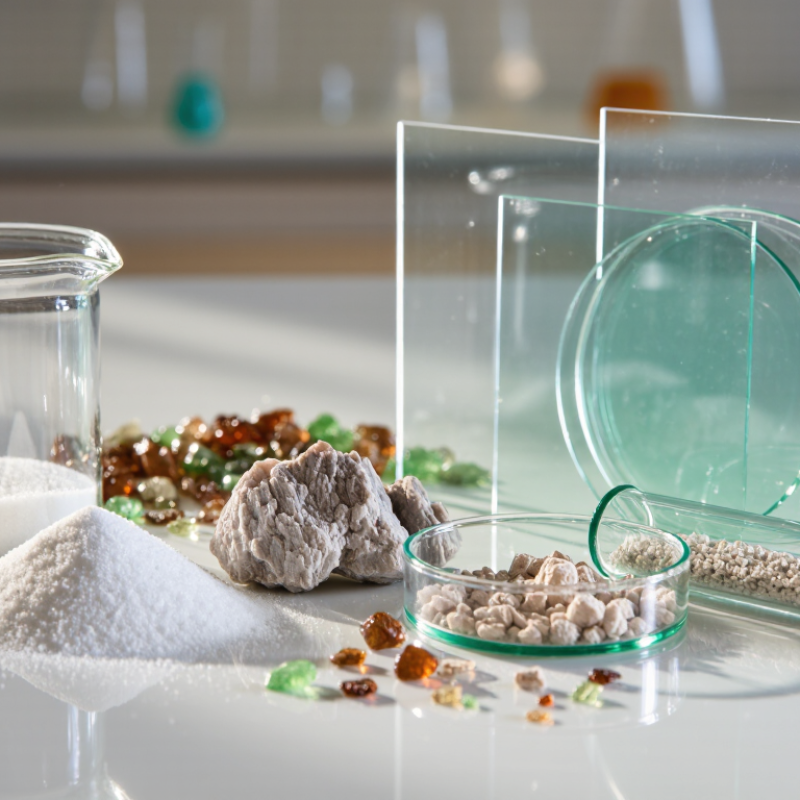
Silica Sand: The Primary SiO₂ Source in Glassmaking
In ordinary soda-lime glass, silica sand supplies the main glass-forming ingredient. Finished glass commonly contains about 70–74% SiO₂ by weight. The exact recipe varies with the product and manufacturing process.
Not just any sand. Glassmakers need sand with high silica content and controlled levels of iron and other impurities; excess iron can tint clear glass green. Grain size also matters because uneven particles may dissolve inconsistently in the furnace. The European Commission’s Glass Manufacturing BREF identifies silica sand as a principal raw material in glass production.
The scale is substantial. The U.S. Geological Survey estimated U.S. industrial sand and gravel production at about 110 million tons in 2024 (Mineral Commodity Summaries 2025). That figure covers multiple uses, not glass alone. It provides context, not a glassmaking total.
Suppliers and manufacturers test composition and particle size, since a deposit’s appearance cannot confirm its suitability. Soda ash lowers the melting temperature, while limestone helps stabilize the finished glass. Silica still does the structural work. It matters.
Yet calling sand the “primary source” can oversimplify the recipe: recycled cullet can also supply silica and reduce the need for virgin raw materials. Recycling rates and batch designs vary, so one figure cannot describe every furnace.
Quartz-Rich Deposits and the Typical 95–99% SiO₂ Feedstock
Glassmakers usually begin with quartz-rich sand or crushed quartz, because quartz supplies the silica that forms the glass network. A typical feedstock may contain about 95–99% SiO₂, though the required grade depends on the product. Clear container and flat glass generally need tighter impurity control than colored or specialty glass. Iron is especially important: even small amounts can tint a melt green. Grain size matters, too. A well-sorted batch melts more predictably than sand containing mixed, coarse particles.
The U.S. Geological Survey’s Mineral Commodity Summaries 2025 estimated U.S. industrial sand and gravel production at 120 million metric tons in 2024. That figure covers many uses, not just glass, so it should not be read as glass-grade supply.
Producers assess silica content and contaminants using laboratory methods such as X-ray fluorescence, alongside grain-size testing. Soda ash and limestone are added later to adjust melting and durability; the silica feedstock is only one part of the recipe. Clean grains help. But “high purity” alone is not a complete specification. Deposit consistency can be easy to overlook, and real-world batches still need testing.
Iron Limits in Clear-Glass Sand: Fe₂O₃ Often ≤0.03%
In 2026, clear glass is commonly made from high-purity silica sand, whose main component is silicon dioxide. For many clear-glass applications, iron oxide is tightly controlled; Fe₂O₃ limits are often around 0.03% or lower. The exact requirement depends on the glass product and the rest of the batch. Even a trace can matter. Iron absorbs light and may give glass a faint green or yellow cast, especially at thicker edges or in stacked panes.
The number on a certificate is only part of the picture. Sand can vary between deposits, and iron-bearing grains may be unevenly distributed through a shipment. Producers therefore test representative samples, often using chemical analysis, and may wash or separate the sand to reduce impurities. A clean-looking handful proves little. The cutoff is not magic, either: melting conditions and other ingredients influence the final color. That nuance is easy to overlook. For buyers, a stated Fe₂O₃ limit should be paired with a clear sampling method and a defined glass application. In practice, consistent results matter as much as a low single reading.
What Type of Silica Is Used in Glass in 2026? — Iron Limits in Clear-Glass Sand: Fe₂O₃ Often ≤0.03%
| Glass application |
Typical silica source |
Indicative SiO₂ content |
Indicative Fe₂O₃ level |
Other important controls |
| Clear container glass |
Washed, screened glass-grade silica sand |
About 99.5% or higher |
Often ≤0.03%; some specifications allow more |
Grain-size distribution, alumina, chromium, and consistency |
| Clear float glass |
High-purity silica sand selected for low iron |
Typically around 99.5% or higher |
Commonly specified around ≤0.03–0.05% |
Low iron supports neutral color and light transmission; limits vary by product |
| Extra-clear architectural or solar glass |
Selected low-iron silica sand, sometimes with additional beneficiation |
Often approximately 99.7% or higher |
Frequently ≤0.015–0.03%, depending on the glass design |
Very low iron is important; titanium and other coloring impurities may also be controlled |
| Amber or green container glass |
Glass-grade silica sand; color is mainly controlled through the batch recipe |
Generally high, with the required grade set by the plant |
May be less restrictive than for clear glass; limits are product-specific |
Colorants and redox conditions determine final color; sand consistency remains important |
| Fiberglass and glass-fiber products |
Specified glass-grade silica sand or other silica-bearing batch materials |
Grade-dependent; commonly high-purity material |
Set by fiber composition and customer requirements |
Alkali, alumina, calcium, and particle-size controls depend on the glass formulation |
Note: Values are indicative industry ranges, not universal specifications. Actual limits depend on the glass composition, color, melting process, and purchaser’s sand specification. Fe₂O₃ is commonly reported as total iron expressed as iron oxide.
Washing, Screening, and Beneficiation Prepare Sand for the Furnace
Glass sand is not simply quartz dug from the ground. It must meet a consistent grain-size range and contain very little clay, iron, and other unwanted minerals. Washing loosens and removes clay films; screening separates grains that are too fine or too coarse. At the plant, water jets turn cloudy with suspended fines. Small grains matter.
Beneficiation may add attrition scrubbing, hydraulic classification, magnetic separation, or flotation, depending on the deposit and the glass specification. These steps reduce contaminants that can discolor glass or disrupt melting. The U.S. Geological Survey’s 2025 Mineral Commodity Summaries estimates U.S. industrial sand and gravel production at about 100 million metric tons in 2024. That figure covers many uses, not glass alone, but it shows the scale of material that must be processed reliably. A clean-looking pile is not proof of furnace-ready sand; laboratory checks for chemistry and particle size still matter. In practice, a screen setting that works on paper may need adjustment when the next batch contains more fines. Processing is precise, but the raw material is not perfectly uniform.
Soda-Lime Glass Contains About 70–74 wt% SiO₂ in Its Final Composition
In 2026, ordinary window glass, jars, and bottles are still commonly made from soda-lime glass. Its main silica source is silica sand, made largely of quartz. A typical finished composition contains about 70–74 wt% SiO₂. Here, wt% means the share by mass in the cooled glass, not the proportion of sand in the original batch.
The other ingredients change how the glass melts and behaves. Soda-derived sodium oxide helps lower the melting temperature, while calcium oxide improves durability. Smaller amounts of magnesium and aluminum oxides may also be present. In a furnace, the batch melts into a hot, viscous liquid; after forming and cooling, silica remains the largest component. That distinction matters.
The exact silica percentage depends on the recipe and intended use. A clear bottle and a window pane may not have identical compositions, even when both are soda-lime glass. For practical checks, manufacturers rely on batch records and chemical analysis, not appearance alone. A clear surface tells you little about its precise SiO₂ content. The 70–74 wt% range is useful, but it is not a fixed specification for every product.